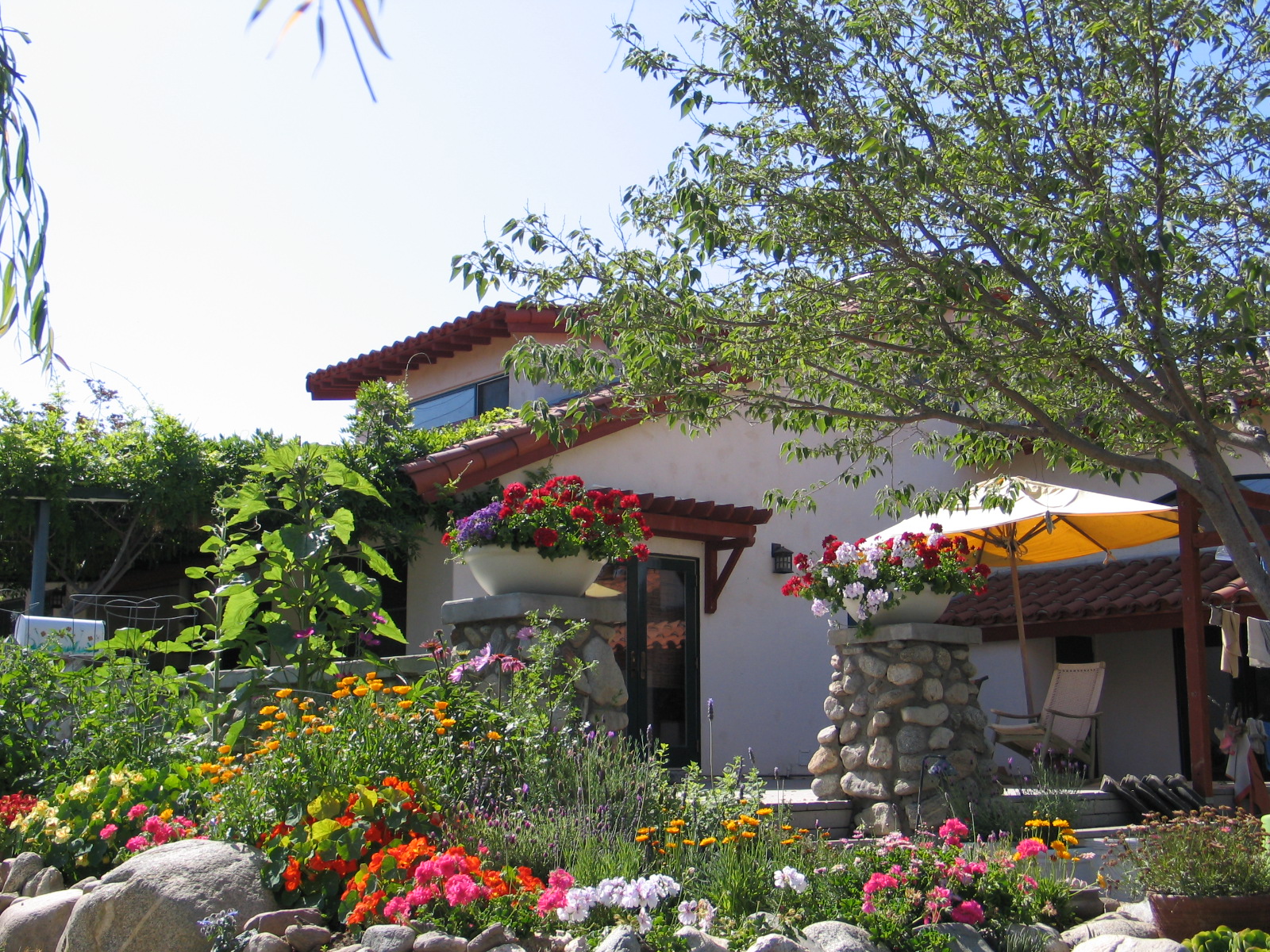
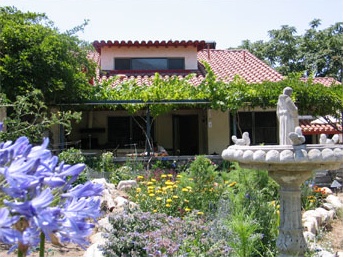
 Welcome to the Myra House Holistic Living Center -
Architecture, Whitehead, and Fulfilling Better Life in Process
In appreciation of this country’s 250th Independence Day — the birth of the United States — I want to dedicate this article to reflecting on my own journey of pursuing a better life in this country over the past 40 years.
- Architecture
During my college years as an architecture major in Korea, the US was my dream country to study abroad. After finishing my undergraduate studies, I began working at an architectural firm, where I channeled my artistic passion into designing buildings that were both functionally better and aesthetically pleasing (1). As my design career developed, two architects in particular inspired me most: Frank Lloyd Wright (1867–1959) and Ludwig Mies van der Rohe (1886–1969). Wright’s organic architecture drew me to pursue advanced academic study. His landmark projects have topped the list of my site visits. I toured his home and studio in Oak Park, and the Robie House in Hyde Park, Chicago. I visited his studio complex at Spring Green, Taliesin, as well as his desert campus in Scottsdale, Taliesin West. And Hollyhock House and Ennis House became routine stops, since I live near Los Angeles. In the design of tall buildings and skyscrapers, meanwhile, Mies’s motto “less is more” led a generation of modern buildings.
Such rigorous projects trained me to value the simplest structural systems, essential detailing, and high-tech building materials such as fiberglass, corrugated metal, and titanium. German-born and the last director of the Bauhaus (1930–1933), Mies emigrated to this country in the late 1930s and became one of the leading architects of the twentieth century, alongside Walter Gropius and Le Corbusier. His progressive ideas were realized in the Villa Tugendhat in Brno, Czechia (1930), the Lake Shore Drive Apartments in Chicago (1951), and the Seagram Building in New York (1958). Above all, the German Pavilion in Barcelona (1928–1929) embodied Mies’s concept of architecture as a “life process” and a “framework for living” (2). Mies seems to have striven for something close to Whitehead’s concept of architecture as a “sustaining and driving force of the modern epoch,” comparable to Whitehead’s premise that science, technology, and industrialization are dynamic factors shaping modern life. In an early lecture, Mies engaged Whitehead’s idea of “prehensive unification,” seeking to extend it into his own work as an architecture that allows concrete experience “here and now,” yet also relates to other places and times (3). Interpreting Whitehead, Mies understood architectural experience not merely as what we see and touch, but as a space that more comprehensively beholds every prehensive stage of entities.
- Whitehead (4)
My journey with Whitehead’s philosophy began with John Cobb’s essay (5) on Paolo Soleri’s Arcosanti. Since then, I’ve come to believe that building a truly sustainable future demands a holistic vision—one bridging religion, the humanities, art, and science. To me, a Whiteheadian approach offers the most practical and persuasive path forward.
According to Whitehead’s philosophy, the reality of all things lies in their interrelatedness and organic growth. Each being and each thing exists in an inseparable web of relationships within a shifting matrix of place, community, and time. Whiteheadian metaphysics holds that feeling is an essential metaphysical category, relevant even to the field of architecture, which recognizes objective criteria of value as well as pivotal subjective experience. Since then, the concept of process-living has oriented my life, making me more conscious of ecological and communal values. Medieval towns and cathedrals can be seen as prime examples: they gather economic life, ritual, and memory into living wholes that hold together many layers of invisible, symbolic, imaginative, and philosophical meaning. In this sense, architecture does not merely occupy space; it gathers histories of feeling, value, and decision into form. Whitehead describes “enduring objects” as societies of events that maintain a recognizable identity through continuous change. Cleopatra’s Needle on the Embankment is such an enduring object, spanning more than 3,400 years from its origins at Heliopolis, through its transport to Alexandria, to its final arrival on the River Thames. The obelisk persists through the ages, while the many occasions around it — cities, cultures, meanings, and interpretations — ceaselessly renew its contextual identity (6).
For Whitehead, the actual world is composed not of inert substances but of actual occasions in relationship. These occasions are organized by patterns of connection, inclusion, intersection, and contrast, and they merge into events that express a momentary “togetherness” of many actualities. Architecturally, rocks, bricks, houses, and mountains can be understood as enduring objects of such occasions, making possible the events of daily life: dwelling, celebration, protest, mourning, and many more. These objects are not closed systems; they are an ongoing assimilation of stability and change. Whitehead’s mathematical imagery helps clarify these relational components in architecture. A straight line can be thought of as composed of infinitely many points, with another point always lying between any two points. Likewise, architectural wholes emerge as finite segments within an extensive continuum of relations: each room, street, or facade is a unique pattern cut from an inexhaustible field of possible connections. Enduring objects are thus not static blocks but dynamic organizations of infinitely fine-grained events. Eternal objects — such as colors, tonalities of natural light, shadow gradients, rhythms of proportion, and acoustic qualities — are the repeatable possibilities that enter into each occasion of experience. In architecture, they appear and disappear as shifting hues, tones, textures, and atmospheres that continually transform a space over the course of a day, a season, or a lifetime. These qualitative patterns give places their “mystic, magical, and poetic” character, allowing a building to be felt differently with each new constellation of weather, time, and human presence.
To experience architecture in a Whiteheadian sense is to prehend it with one’s whole body — through vision, sound, movement, and social engagement — in a mode of heightened, but irreducible, awareness. Perception is not merely optical; it is a bodily integration of causal efficacy — a subjective awareness of how the environment feels and affects us. To design and inhabit architecture through this relational lens is to cultivate projects that are adaptive and dynamic, resonant with life’s complexity and the passage of time, while pursuing beauty. This is one way in which process thought has informed, and can continue to inform, contemporary practices — from the rigorous minimalism of Mies to the pattern languages of Christopher Alexander, the arcologies of Paolo Soleri, and the fluid forms of Frank Gehry.
III. Better fulfilling Life in Process
In 2001, the Myra House project began with the renovation of the Sohn family home into a cross-culturally dwelling place, as a few residents committed themselves to exploring an ecologically sustainable way of life in daily practice. Since then, three projects have been completed as concrete expressions of this ongoing experiment in earth-friendly living. Since the house was rebuilt in 2001, the notable completed projects are Francis Ring (2020–2021), Hwa Bang (2022–2023), and Byeol Jeong (2024–2025).
Each project begins as a demanding yet adventurous effort to weave existing conditions into a new and singular outcome. I have become convinced that a key lesson of process-living, as practiced through architectural projects, is that certain qualities can be both aesthetically compelling and ecologically sound. As design evolves, small adjustments emerge in response to expanding needs and diverse inputs, echoing Whitehead’s dictum that “the many become one, and are increased by one.” This generative process invites better fulfilling life of unexpected collaboration and participation, engaging new techniques, new materials, and wider communities, thereby enriching the shared environment. Through this lens, Myra House, as a small-scale intentional community, has convinced me that it can serve as a living model of what it means “to live, to live well, and to live better(7),” seeking harmony with a larger cosmic order.
Notes
(1) In theory and practice, architecture generally concerns three interrelated aspects: firmitas, utilitas, and venustas (i.e., structural stability, appropriate spatial accommodation, and attractive appearance). Vitruvius, the Roman architect of the 1st century BCE, set these out in his treatise De Architectura (The Ten Books on Architecture), advocating broad knowledge across various fields — mathematics, philosophy, music, and astronomy — to ensure harmony and unity with the site design.
(2) L. Mies van der Rohe, “Lecture” (19 June 1924), in F. Neumeyer, The Artless Word, op. cit., pp. 249–250.
(3) Victoria Watson, Haunting: Whitehead & Mies (An Air Grid Publication, 2018).
(4) Alfred North Whitehead (1861–1947), born in England, was a mathematician and logician who became a philosopher at Harvard (1924). His core idea of process-relationality has been explored in relation to music, poetry, the fine arts, film, and the performing arts. His metaphysical thought has also called for ecological sensibility in dealing with the natural world, calling attention to picturesque beauty, mystic sublimity, and biotic diversity. Among his well-known published books are Process and Reality (1929), Adventures of Ideas (1933), and Modes of Thought (1938).
(5) John B. Cobb Jr. (1925–2024), process theologian and a leader of the Ecological Civilization movement, which seeks to move beyond a human-centric and mechanistic, power-driven civilization. This aspiration has given rise to a network of affiliated groups that promote a process-relational worldview inspired by the work of A. N. Whitehead.
(6) On Cleopatra’s Needle, see A. N. Whitehead, The Concept of Nature (Amherst, NY: Prometheus Books, 2004), 165ff. On the generic identity of an event, see Process and Reality.
(7) Whitehead. Process and Reality (1929), Part III, Chapter II (“The Categorical Scheme”), Section IX. He elaborates that the art of life is threefold: to live, to live well, and to live better, with Reason as the factor that directs this threefold urge.